Showing posts with label organic wireworm control. Show all posts

Wednesday, March 30, 2011

Companion Planting and pest control

This list summarises some commonly held beliefs about the uses of companion plants, and basic anti-pest precautions I have coveed here before.

Firstly, slugs. Beer traps, copper bands and a good defense in building of slug hostile paths are primary.

Encourage Toads, Frogs and Hedgehogs by providing safe havens, dried cat food t attract them (this will also attract slugs so spread it away from veg beds) and shelter.
Their menu include cutworms, crickets, grubs, chafers, caterpillars, ants, moths, flies, slugs.
They are your friends, welcome and love them,be gretful if you have them.

Slugs are most active at night and are most efficient in damp conditions.
Go slug lamping at night, its fun. At dusk, go out in the garden with  torch and a knife and kill them on sight, every slug you kill stops hundreds more being born

Far and away the best course of action against slugs in your garden is a simple adjustment in the watering schedule. Avoid watering your garden in the evening if you have a slug problem. Water in the morning - the surface soil will be dry by evening.
Studies show this can reduce slug damage by 80%.

Secondly, the more insidious underground pests, cutworms, leather jackets et al, especially when opening up new grass land for veggies - use supernemo - a great Irish product that I found to be outstandingly effective.

In my own - non scientific - tests, supernemo outperformed nemasys, another pest control pack, and also I could clearly see that beds treated with suprnemo had little or no crop damage,whereas the few extra beds I threw in the garden that were not treated with supernemo but nemasys suffered very badly - in particular root crops.


SuperNemos are an Irish made bio-control product that contains a wider range beneficial nematode species.

SuperNemos is environmentally friendly, harmless to wildlife, earthworms,bees, bumblebees, pets and kids.

It attacks only target insect pests. There is no need for masks or specialized safety equipment.
This product will control Vine Weevil, Wire worms, Strawberry Root Weevils,Carrot Fly, Weevils, Chafer Grubs, Caterpillars, Cutworms, Leatherjackets, Beetle larvae, Cabbage caterpillar's, Flea beetle, Cabbage root fly, Fungus Gnats Larvae and many more!

SuperNemos will attack its target insect species; the nematodes enter the host through body openings or by penetration of the body wall. Once inside they kill the host within 48 hours.

Now the plants and their companions:

Allium--flowering onions, chives, garlic, leek, onion and shallot
Companion to: Roses, carrots, tomato, fruit trees and other vegetables
Repel aphids, weevils, carrot flies, moles, fruit tree borers; controls rust flies; protects tomatoes against red spiders. Protects roses from black spot, mildew and aphids.
BUT is believed to inhibit growth of peas and beans.

Basil
Companion to: Tomato, asparagus
Repels aphids, flies and mites; helps control insect pests such as tomato horn worms, asparagus beetles, and disease.

Beans (Butter, green, snap, string,wax)
Companion to: Beets, carrots,cucumber, corn, aubergine, potato,strawberry
Encourage growth of companion plants. Adds nitrogen to the soil.

Borage
Companion to: Tomato, strawberry, fruit orchards
Repels tomato worms. Adds potassium, calcium and other minerals to soil. Attracts honeybees.

Chamomile
Companion to: Cabbage, onions
Improves growth and flavor--but plant only one plant every 150 feet or so.

Catnip
Companion to: Aubergine. Fresh catnip steeped in water and sprinkled on plants will drive away flea beetles.

Celery
Companion to: Cabbage, leeks, tomato, cauliflower
Improves growth of companion plants. Repels white cabbage butterflies.

Chervil
Companion to: Radish. Improves growth and flavor.

Chive
Companion to: Carrots. Improves growth and flavor.

Coriander
Companion to: Vegetables. Repels aphids. Attracts bees.

Cucumber
Companion to: Sweetcorn, beans, peas, radish, sunflowers
Improves growth. Vines growing with corn help anchor sweetcorn.

Dill
Companion to: Cabbage. Improves growth. Blossoms attract honeybees.

Fennel
Most plants dislike fennel--so plant it away from the vegetable garden.
Its foliage and flowers may attract beneficial insects.

Geranium
Companion to: Cabbage, corn, roses. Repels cabbage worms.

Horseradish
Companion to: Potato. Encourages growth.

Hyssop
Companion to: Cabbage. Improves growth, deters cabbage moth.

Leek
Companion to: Carrots, celery, onions. Improves growth, repels carrot flies.

Marigold
Companion to: Tomato, potato, strawberry, beans, roses
Encourages growth, deters some pests.
Discourages harmful nematodes if they are grown for several seasons in the ground in areas that have nematode infestations.

Mint
Companion to: Tomato, cabbage. Improves flavor and growth

Mustard
Companion to:Cabbage, cauliflower, radish, Brussels sprouts, turnips, collards, kohlrabi
Plant mustard as a trap crop. It attracts numerous insect pests. Remove and destroy it before your main crops can be harmed.

Nasturtiums
Companion to: Cucumber, other vegetables, fruit trees.
Repels aphids,cucumber beetles and white flies.
Acts as trap crop for aphids. Repels borers near fruit trees.

Onion
Companion to: Cabbage, cauliflower, broccoli,beets, tomato, lettuce, strawberry, chamomile, summer savory
Repels aphids, weevils, carrot flies, moles, fruit tree borers; controls rust flies and some nematodes;
Protects tomatoes against red spiders. BUT is believed to inhibit growth of peas and beans.

Oregano
Companion to: Broccoli, brassica's .Repels cabbage butterfly.

Parsley
Companion to: Asparagus tomato, roses.
Deters asparagus beetles.Improves growth. Deters rose beetles.
Nigel from chillington hoes also informed me that parsley is related to carrots and parsnips and will not deter carrot fly and will actually be attacked by them.

Peas
Companion to: Sweetcorn
Adds nitrogen to soil for use by hungry corn plants. Grows well with carrots, turnip, radish, cucumber, beans and potatoes.

Pennyroyal Broccoli,
Companion to: Brussels sprouts, cabbage, other plants. Discourages ants, plant lice, cabbage maggots.

Radish
Companion to: Cucumber. Deters cucumber beetles.

Rosemary
Companion to: Carrots, cabbage, beans  Repels carrot flies, bean beetles, cabbage moths.

Sage
Companion to: Carrots, Brassica's. Repels carrot flies, cabbage moths.

Summer savory
Companion to: Green beans. Improves growth, deters bean beetles.

Tansy
Companion to: Cucumber, squash, roses, raspberry, blackberry.
Deters flying insects, striped cucumber beetles, ants, flies, squash.
BUT, attracts cabbage worms.

Thyme
Companion to: Cabbage
Controls flea beetles, cabbage maggots, cabbage worms and white cabbage butterflies.

Wormwood
Companion to: Various plants  Deters black flea beetles, cabbage worm butterflies. Highly Poisonous


Free Stats Hit Counter Web 
Analytics

Tuesday, December 7, 2010

Winter Garden Work

So, things are running out, and in the first year of this garden I have learnt a lot.
I will be expanding the plot with two more beds, and cutting surrounding trees to provide more light to the veg patch.

I think the best idea I had last year was the pathway preparation, with the pine needles and ash, it did help against the slugs.
It also gives room to dispose of stones in the beds, a problem we have here in the west.
I am currently renewing the path ways, building them up with needles and ash, to further develop the passive anti-slug barrier.

I already wrote about some of the winter plantings in a previous post.
Other work has been to use the recent cold snap to my advantage, turning the soil to expose the earth to the frost, which breaks it up and I hope it will also kill of some parasites.
Certainly the birds appreciate it when the earth is turned over, as the go in and pick off insects.

I will also start to put down traps for wireworms as well, early in the season to get as many as possible.
From what I have read, the longer the garden is established - the less of a problem they will be as they are worst in new gardens after grassland has been converted to cultivating veg.

Its also time to start thinking about enriching the soil. Along with seaweed I have found that Delaney and Delilah have quite tidy toilet habits - not something I expected from Donkeys, but most of the manure is centred in a few places.
So, with seaweed and donkey doo-doo dug in, I hope that will be enough for my fertilizer needs for 2011.

Weeds growing on the path edge are a pain, there is nothing for it but to hoe them out and backfill with ash and needles.
I am tempted to treat the paths with organic weedkiller, but I'm fairly concerned about salt leaching into the beds.
I do expect to be away a lot more next season, so the garden will have to be low maintenance.
One thing for certain, one of the beds - the one with the rhubarb - is being converted to a different type of bed, with Jerusalem and Globe artichoke, asparagus, herbs, fruit bushes and other annual plants that will be there on a permanent basis, not rotated.

So that's it, my Irish winter vegetable patch - still producing food and getting ready for 2011.
As always, please take the time to comment, I really appreciate the feedback.


Free Stats Hit Counter Web 
Analytics

Monday, June 7, 2010

Organic wireworm control, SuperNemos and traps

Well, when I pulled a few Milan Purple Tops for Caldo Vedi, mostly for the greens, I found fairly severe damage to the three small turnips, and found one obvious perpetrator.

Wireworms are a menace, and on research I found out this is particularly true on new gardens, where one had grass growing before.
I wished I had looked into it earlier, but that's life and I hope to limit potential damage.

Going on the usual offensive, I looked into active and passive means of combating these horrid little creatures.
Active attack was nematodes from nemo.ie and passive defence was a home made trap

WIRE WORMS / CUT WORMS
On investigation, I found - on the excellent garden plans Ireland forum (link on right hand panel) that wire worms are the larvae of the Click Beetle. 
Click beetles come in a variety of shades and colours, but, pick them up and you will know them , they flick the body to escape and make a clicking sound. They themselves are harmless to crops, but - as always it seems  it is the juveniles who are the real delinquents.

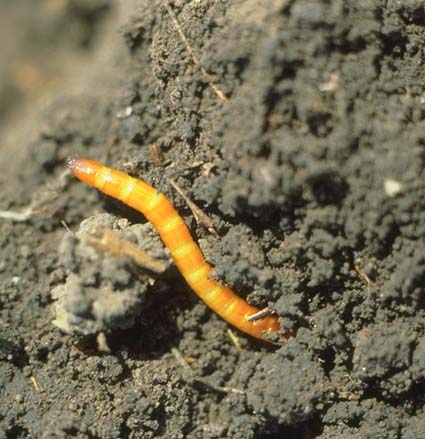
The Larvae themselves seem pretty unmistakable.
A yellow/orange segmented semi hard exoskeleton, they are fairly easy - I think - to identify.
Certainly the pictures on the net look just like them.


With pictures from the forum, and the fact that I had found click beetles it is a safe conclusion that this is the major problem.

Cutworms are another parasite - the larvae of a moth.

Like the leatherjacket, these are insidious little creatures, banging away below the surface and damaging crops unseen until it is too late.

I had previously applied a packet of nemasys grow our own from mrmiddleton.com which controls Carrot root fly, cabbage root fly, leatherjackets, cutworms, onion fly, sciarid fly, caterpillars, gooseberry sawfly, thrips, and codling moth.
Obviously, from the damage, it had not attacked the wire worms.

Recommended by me

SuperNemos are an Irish made bio-control product that contains a wider range beneficial nematode species.
SuperNemos is environmentally friendly, harmless to wildlife, earthworms,bees, bumblebees, pets and kids.


It attacks only target insect pests. There is no need for masks or specialized safety equipment.

This product will control Vine Weevil, Wire worms, Strawberry Root Weevils,Carrot Fly, Weevils, Chafer Grubs, Caterpillars, Cutworms, Leatherjackets, Beetle larvae, Cabbage caterpillar's, Flea beetle, Cabbage root fly, Fungus Gnats Larvae and many more!


SuperNemos will attack its target insect species; the nematodes enter the host through body openings or by penetration of the body wall.
Once inside they kill the host within 48 hours.
So, I dosed up all the beds, but went fairly heavy on the root crops, and hope the nematodes massacre the buggers that bother my bumper crops.

I found the SuperNemo easier to use than the nemasys type.
It is more economic, being a broad spectrum attacking insect, with the nemasys you need to shell out for each particular pest.
It was less lumpy/congealed than the nemasys I had used before.
It dissolved in the water easily, whereas the nemasys seemed to take more work.
I think this is due to the packaging.


TRAPPING
Trapping is to indicate the level of infestation, it will trap some, but the primary safe, effective and organic way to deal with cut worms etc is still the supernemo's.

The simplest way to trap these buggers is just skewer some raw potato on a stick and bury it in the ground.
You could set some potato traps in your planned planting area about three weeks before you plant the crop.
Dig a series of four-inch deep holes throughout the planting area, pop in half a potato, cover with soil, and mark with a stick.
A day or two before proper crop planting, dig up the traps, which now hopefully contain the wireworms to be disposed of.

Because of my worries about infestation - and wanting a more robust system, I did a little further research.
These guys are opportunistic pests, they attack most root crops.
I also found out they are attracted to carbon dioxide, which plants produce when the germinate
I got an empty cat food tin and using a 6" ail punched a series of holes in the side and the bottom.
The nail stays in the tin to secure the bait.

Then I baited it with a potato and peels, a bit of carrot etc. - the crops that one finds in that particular bed.
Peelings and scrapings can be used for this.

In addition, for this experiment, I loaded the spud with some baking powder soda, which gives off CO2 when it gets wet, that's why it is used for rising bread.

I plan on getting one of those plastic tin sealers and perforating that to improve on the design.
I buried the tin about 10cm into the ground, so that means the trap is at different depths.

It was then marked with a flag stick for recovery next week and covered over
In the photo above you can see two home made traps in position and baited, the beer trap for slugs and the buried wireworm trap
Anyway, I will update on how it works as the season goes on, as these beasties dig deeper over the course of the year.


Free Stats Hit Counter Web 
Analytics