This is an easy to do and complex in flavour watermelon curry from Rajasthan.
The flavour is earthy due to the cumin and coriander, with a hint of
heat from the chilli - but once you bite into the melon chunks there is
this great burst of sweetness and juiciness - a great combo and a real
surprise.
The colour is spectacular, I wish the photos reflected it.
Above, served with a Goan Pork curry with a simple lentil dahl.
This is a great dish, in particular a great, unusual and interesting side for big BBQ's.
It only takes about 20 minutes to do.
Inspired again by the great Camellia Panjabi whose inspiring and definitive book '50 great curries of India' introduces accessible Indian food in all its glorious regional variety.
What also surprised me was how easy it is to reheat - and if done gently the watermelon will retain its bite and form without turning into mush. Harder than you think!
Pretty straight forward - this will easily yield 8 large portions
You will need
--------------------
1/4 of a water melon
1&1/2 teaspoons of chilli powder
Pinch Turmeric powder
1/2 Teaspoon of Coriander powder
Crushed and pureed Garlic - good Teaspoon.
Salt
Teaspoon of Cumin seeds
Ghee, Coconut oil or oil (I used coconut for this - made it vegan)
2 - 3 teaspoons lime juice
-----------------------------
De-seed the melon as best as you can
Chop up the flesh of the watermelon into good sized chunks - about 4cm/1.5 inch chunks.
Take about a cup of the chunks and blend them to a liquid with the chilli, turmeric, garlic and salt to taste.
Now heat the oil in a wok or pan, when its hot chuck in the cumin seeds and sizzle them for about 20 seconds. It gives the oil the earthy flavour.
Add the blended watermelon and spice mix - bring to a simmer and leave sit for about 5 minutes.
Then reduce heat, add the watermelon chunks, spooning over or tossing the chunks gently in the juice.
Add the lime juice about 2 minutes from the end.
Serve and enjoy.
Please feel free to comment or leave feedback - I really appreciate the effort.
Just for fun - how to open a coconut, first take (more about that later)
Thanks to Brian for the camera work
John Dory is a sustainable fish, generally a bycatch in the fishing industry.
It is in demand, a really nice meaty fish, so a bit on the expensive side, but sooo worth it.
Apart from John Dory, other good fish are pollock, hake, bream - any meaty white fish.
Also Sea Bass, Bream and Dover Sole are really good alternatives.
This takes about 20 - 30 minutes for a really lovely late summer light dinner.
Please feel free to comment - I really appreciate the time and effort when people do.
This recipe is really influenced by Tony Singh - born and raised in Leith (with as strong a Leith accent as I've ever heard on TV) You may have seen him, as I did.
He is among Scotland's leading contemporary chiefs, and coming from Leith really knows fish.
Having watched him on TV, he did make me think, he is quite inspiring - as a chef he takes traditional Scottish food, and re-invents it.
In a way, this is a meal that is a tribute to his energy and ideas.
I love his demeanor and the way he approaches food. His original version uses Dover Sole. It seems to me to be a sort of Parsee style Buerre Noissette, mine is more like an Indian Hollandaise - if anything, more Indian than the original.
I served this dish with new potatoes and asparagus.
Red Gurnard - a meaty, economic, tasty and sustainable fish, Scale 3 on the Marine Conservation Societies (MCS) list (*See note at end of article)
This type of fish, bony, bottom dwelling, is not usual on the menu - but they are great.
Very common in North African and Middle Eastern cuisine, this recipe is inspired by Turkish and Lebanese food. Good recipe for the more expensive red snapper as well.
I like my fish on the bone - but you can use fillets if you prefer.
The fish is not in great demand in Ireland, I picked these beauties up from Cork cities English Market - Ballycotton seafoods - along with the samphire, for €3.50, with rice can easily feed 4 or a greedy dinner for two.
This meal itself is great with rice, giving it almost a risotto effect.
The rice will cook in about the same time as it takes to cook the fish and veg.
The sauce, with egg, lemon and cream is kind of a Mediterranean hollandaise - rich and velvety. You will need a pan or heavy based pot with a lid or plate that can cover the pan.
INGREDIENTS
Good knob of butter
Fish - 2 or 4 red gurnard fish/fillets, or red snapper - meaty white fish.
1 small onion, chopped
1 garlic clove, crushed
115 grm button mushrooms (about 9)
1 tomato - skinned, de-seeded and peeled
1 tablespoon - good squeeze - tomato puree
1 egg yolk
4 tablespoons cream
2 tablespoons lemon juice Parsley to garnish .
Melt the butter in a large frying pan.
Cook the onion for 2 - 3 minutes until softened or translucent but not browned.
Add Garlic and cook for another minute, then chuck in your mushrooms, tomato and tomato puree and season to taste.
Cook down for about 5 minutes.
Put the fish fillets on top of the veg and pour over the water.
Bring to the boil, then reduce the heat to medium/low, cover the pan and leave simmer gently for 10 minutes.
There is a trick to this dish.
While waiting for the fish to cook, whisk up the egg yolk and lemon to emulsify- go easy on the lemon juice, you can add more later to taste, After whisking the egg and lemon add the cream and whisk in.
When cooked, remove the fish and keep warm.
Stir the egg/lemon/cream mixture into the veggies and blend, constantly stirring.
Taste the sauce, add pepper and salt to season as wanted, add more lemon juice to taste if you overdo the lemon, a pinch of sugar will bring it back.
Pour sauce over fish and serve.
I served the fish on a sushi rice with tomato and samphire mini salad on the side.
Also very good just with salad.
I hope you enjoy this recipe - please take the time to comment, I really appreciate the time and effort.
* MCS scale 3 - eat but not too often.
Red gurnard is a fast growing fish and matures early at a large size.
Avoid eating immature fish (less than 25 cm) and fresh (not previously
frozen) fish caught during the spawning season (summer).
A fiber and fruit filled breakfast treat based on a recipe by Janet Kalman Villada.
It takes its inspiration from traditional soda bread, and uses soda, buttermilk and blackberries (fresh or frozen) in its composition.
If you want it fresh in the morning you can leave the mixture overnight in the fridge.
For me its a handy thing to make when baking bread or pies anyway - so you don't waste energy.
The batch is sufficient for 11 or 12 muffins
You will need:
75 grms (1 cup) wheat bran
250 ml (1 cup) buttermilk - yogurt can be used as a substitute or a mix.
80ml (1/3 cup) rapeseed oil or other vegetable oil. Unsweetened applesauce can also be used
1 egg
95 grms (2/3 cup) brown sugar
125 ml (1 cup) self raising flour
teaspoon baking soda
teaspoon baking soda
pinch salt
About a 100 grms (1/2 cup) blackberries (you can also use other seasonal fruits or raisins)
You can add some vanilla extract if you like Preheat oven to 190 degrees C (375 F)
Grease muffin cups or line with paper muffin liners. Mix together wheat bran and buttermilk; let stand for 10 minutes.
Beat together
oil, egg, sugar (and vanilla if wanted) and add to buttermilk/bran mixture. Sift
together flour, baking soda, baking powder and salt. Stir flour mixture
into buttermilk mixture, until just blended. Fold in any desired fruits and spoon
batter into prepared muffin tins.
Bake for 15 to 20 minutes, or until a toothpick inserted into the center of a muffin comes out clean. Try not to overcook - 15 minuted should do it in a fan assisted oven.
One of the perennials I planted back in 2011 has kept going strong with no attention whatsoever - as has the cordoon etc.
With this meal, unfortunately I left my stick with photos at home, so I will upload some on my return.
You will have to make do with the rather pretty botanists painting above.
There are many variations, this is simple, peasant food - but once it starts to caramelize, it starts to become the food of Kings. First time I saw it was on a UK site from a Welsh lad called Alan Refail - so thanks to him, I have something other than a soup or puree option.
Jerusalem artichoke is hardy, and is suited to the Irish climate. After it was established it has required no weeding or care.
In terms of sourcing tubers, after my experience, I would, unfortunately, not recommend Mr Middleton's.
Try looking about, or contact me. I have quite a stick of them.
Mind you, when I did put it in, a lot of seaweed and manure went in as the base of the bed.
Since then I have had strong, healthy plants.
The fresh tuber tastes like a water chestnut and is used in salads. They are better cooked though as they will give you wind if raw - and I really mean that - as did John Goodyer in 1621 when he was quoted as having said "which way soever they be dressed and eaten, they stir and cause a filthy loathsome stinking wind within the body, thereby causing the belly to be pained and tormented, and are a meat more fit for swine than men."
Dont let that put you off, it is a bit harsh. The flavour of Jerusalem artichoke is kind of sweet and smokey. If lifted and stored for any length of time, they become sweeter - so if using this recipe, dig the tubers up a few days in advance, it really helps with the caramelizing process.
This recipe Topinambours à la Barigoule, is a staple of Provence in the south of France, it's cheap, easy and different.
I like to keep it simple, and the recipe here is fantastic with roast pork.
INGREDIENTS (serves 4)
500 grams Jerusalem artichokes, scrubbed and peeled
1 Lemon
100ml white wine
100ml of water or stock
2 garlic cloves finely chopped
12 Black olives, stoned
Handful of Parsley
Chop up the Jerusalem artichokes and cut into about 1 inch / 2 cm pieces.
Put them in a pan that just fits them and add two or three tablespoons of rapeseed or olive oil, the juice and grated zest of a lemon, about a dozen black olives, 100ml water (or veg/chicken stock) and 100ml of white wine.
Add water to barely cover them tightly, bring to the boil then simmer till the artichokes are tender.
Uncover and let the liquid evaporates and the artichokes are just starting to caramelize.
Season with pepper, no need to use salt normally the olives are salty enough.
Add a good handful of chopped parsley before serving.
Great side dish - enjoy
As always, please take the time to comment - I really appreciate the time and effort.
St Patrick's day, start of the growing season - so whats left?
Well, I'm stuck in Norway at the moment, but it does not mean I can't
did up an old recipe to share.
Cabbage or kale is available all year round if the garden is planned
well, its good for you, full of vitamin C, minerals and fiber.
This dish goes well also with pureed Jerusalem artichoke which are
hardy, the smokey flavour works well with the bacon. Another good option is
pureed parsnips - just to give some body or variety.
In this dish it combines nicely with vinegar to offset salmon's
richness.
Feeds 4 people.
1 small cabbage (about 1 lb.)
4 6-oz. salmon filets
1 tbsp. extra-virgin olive oil
Salt and freshly ground black pepper
250 grams (1⁄4 lb.ish) thick-cut bacon, diced
60 ml (1⁄4 cup) dry white wine
60 ml (1⁄4 cup) cup cider vinegar
100 ml (1⁄2 cup) Fish Stock or water
100ml (1⁄2 cup) heavy cream
1 tbsp. chopped fresh dill
1 tbsp. chopped fresh chives
1. Using a mandoline or knife, shred cabbage or kale 1⁄2" thick.
2. Brush or rub both sides of salmon filets with olive oil and season
with salt and pepper. Sear filets in a large skillet or grill pan over high
heat, until evenly browned, about 2 minutes per side. Transfer to a plate and
set aside. Wipe out pan with paper towels.
3. In the same pan, cook bacon over medium heat until crisp, about 10
minutes.
Remove bacon, leaving fat in the pan. Drain bacon on paper towels and
set aside. Add cabbage and/or kale to the bacon fat and cook 5 minutes.
Add
wine, vinegar, stock, and cream. Cover and cook until cabbage is wilted, about
15 minutes. Reduce heat to low and place salmon filets in pan over wilted
cabbage and/or kale.
Cover tightly and cook until salmon is firm to the touch, about 10
minutes.
4. To serve, spoon cabbage/kale onto plates and sprinkle with the crisp
bacon. Top cabbage with salmon filets and a spoonful of pan juices.
Garnish
with dill and chives.
=====================
SURF AND TURF - A NOTE ON BEEF AND SALMON
Just a note for American readers on this day - you might be
surprised to learn that your traditional St. Paddy’s meal—corned beef and
cabbage—is as Irish as spaghetti.
The first St. Patrick’s Day parade took place not in Dublin but in New
York City, in 1762.
Over the next 100 years, Irish immigration to the United States
exploded.
The new wave of immigrants brought their own food traditions, including
soda bread and Irish stew.
Pork was the preferred meat, since it was cheap in Ireland, as was
salmon, and ubiquitous on the dinner table.
The favored cut was Irish bacon, a lean, smoked pork loin similar to
the Canadian type familiar in the USA.
However, in the United States at the time, pork was prohibitively
expensive for most newly arrived Irish families, so they began cooking beef—the
staple meat in the American diet—instead.
So how did pork and potatoes become corned beef and cabbage?
Irish immigrants to America lived alongside other “undesirable”
European ethnic groups that often faced discrimination in their new home,
including Jews and Italians.
Members of the Irish working class in New York City frequented Jewish
delis and lunch carts, and it was there that they first tasted corned
beef.
Cured and cooked much like Irish bacon, it was seen as a tasty and
cheaper alternative to pork.
And while potatoes were certainly available in the United States,
cabbage offered a more cost-effective alternative to cash-strapped Irish
families.
Cooked in the same pot, the spiced, salty beef flavored the plain
cabbage, creating a simple, hearty dish that couldn’t be easier to prepare.
After taking off among New York City’s Irish community, corned beef and
cabbage found fans across the country. It was the perfect dish for everyone
from harried housewives to busy cooks on trains and in cafeterias—cheap, easy
to cook and hard to overcook.
It was even served alongside mock turtle coup at President Lincoln’s
inauguration dinner in 1862.
It is as American as apple pie.
Mayor of Cork - Gerald Goldberg
That is not to say that Ireland does not have a tradition of cured
beef. In a quirk of history, with a large Jewish population, spiced beef is
popular in Cork. It is a Jewish way of preparing meat that has become a staple
of Cork life, no table in Cork is without it at Christmas.
Shalom park and Mayor Gerald Goldberg, whose wife worked with my Grand-mother in Cork for special need's kids, are just part of Cork's
historical and cultural fabric. An excellent article on Cork's Jewish community can be read on historian Cllr Kevin McCarthy's blog.
The best spiced beef in Cork is, in my opinion, Tom Durkins in the English Market
Waterford has a traditional corned beef, and that is normally also
available at Toms stand.
If you get the chance, I heartily recommend you try spiced beef is in a sandwich, and with a bowl of soup ( or a glass of Midaza - a new local stout in the City) at Arthur Maynes. It is the perfect late lunch, a fantastic spot in Cork to soak up some of the local history, atmosphere and culture close to the English market.
Enjoy, have a great St Patrick's weekend - please do take the time to
comment
This is a Japanese style breaded and deep fried pork dish. Like rookworst and endive in Holland, Caldo Verde in Portugal or our own bacon and cabbage the essence of this meal is those good companions, pork and cabbage. I've added a Japanese staple, quick pickled veg to give it a little more of an oriental feel, and any excuse to incorporate seaweed in a dish is good with me. Pickles take about 2 hours but are better overnight.
This recipe is based on one I found in Fionas Japanese cookbook blog Fionas recipe is really good, the main change I did was to incorporate fresh garden herbs and some mustard powder into the egg mix.
I pureed some parsley, chives, wild garlic leaves with half a teaspoon of mustard powder and beat in an egg.
I just did home-made breadcrumbs. Fiona talks about Panko flakes, but being in Connemara at the time, Asian supermarkets are tricky to find - unless your in China town on Craggy Island. Cut off the crusts, toast and crumble onto a baking tray, stick into a warm oven or under a grill for two minutes - simple as that.
For the chops - Trim the fat off the pork chops if you prefer not to eat the fat, I just take off the rind. Score small cuts all around the edge of the pork chops Coat the pork chops in some seasoned flour (shaking off any excess flour) Dip the pork chops in the beaten egg, mustard powder and herb mix.. Finally coat in the bread crumbs (rub the crumbs gently onto the pork chops).
Cook in a heavy based saucepan or cast iron frying pan - the oil should come half way up the chops.
Oil needs to be very hot - sizzling, about 140 C.
Turn and cook until golden brown all over
If serving with chopsticks dond forget to slice up the pork - and it makes for nicer presentation I feel.
Tonkatsu sauce
1 tsp. dry mustard powder
50ml cup ketchup
25ml Worcestershire
2 tsp. soy sauce
2 tsp Yorkshire relish (optional)
Whisk
together mustard and 2 tsp. water in a bowl until smooth. Add ketchup,
Worcestershire, and soy sauce, and whisk until smooth.
Sweet and sour cucumber and wakame pickles (kyuuri to wakame no amasuzuke) as a side dish - and the meal is served with Sushi rice and home grown greyhound cabbage.
Japanese style Pickled Cucumber
This amount of marinade is enough for one large
cucumber - the long, relatively thin kind that often comes shrink-packed
in plastic. If you’re using other gherkins, aim for about 4 to 5 cups
cut up.
The marinade:
8 Tbs. rice wine vinegar (not sushi vinegar)
10 cm square piece of kombu seaweed, its a kelp if you are foraging.
1 1/2 Tbs. sugar
1 tsp. sea salt
4 Tbs. boiling water
Half a red chili pepper (optional; leave out if you don’t want any spiciness)
Combine and mix until the sugar is melted.
The vegetables:
1 large cucumber
2 Tbs. dried pre-cut wakame seaweed ( the kind that just requires soaking)
De-seed and cut up 1 cucumber
Put the marinade in a small glass, ceramic or plastic bowl (not
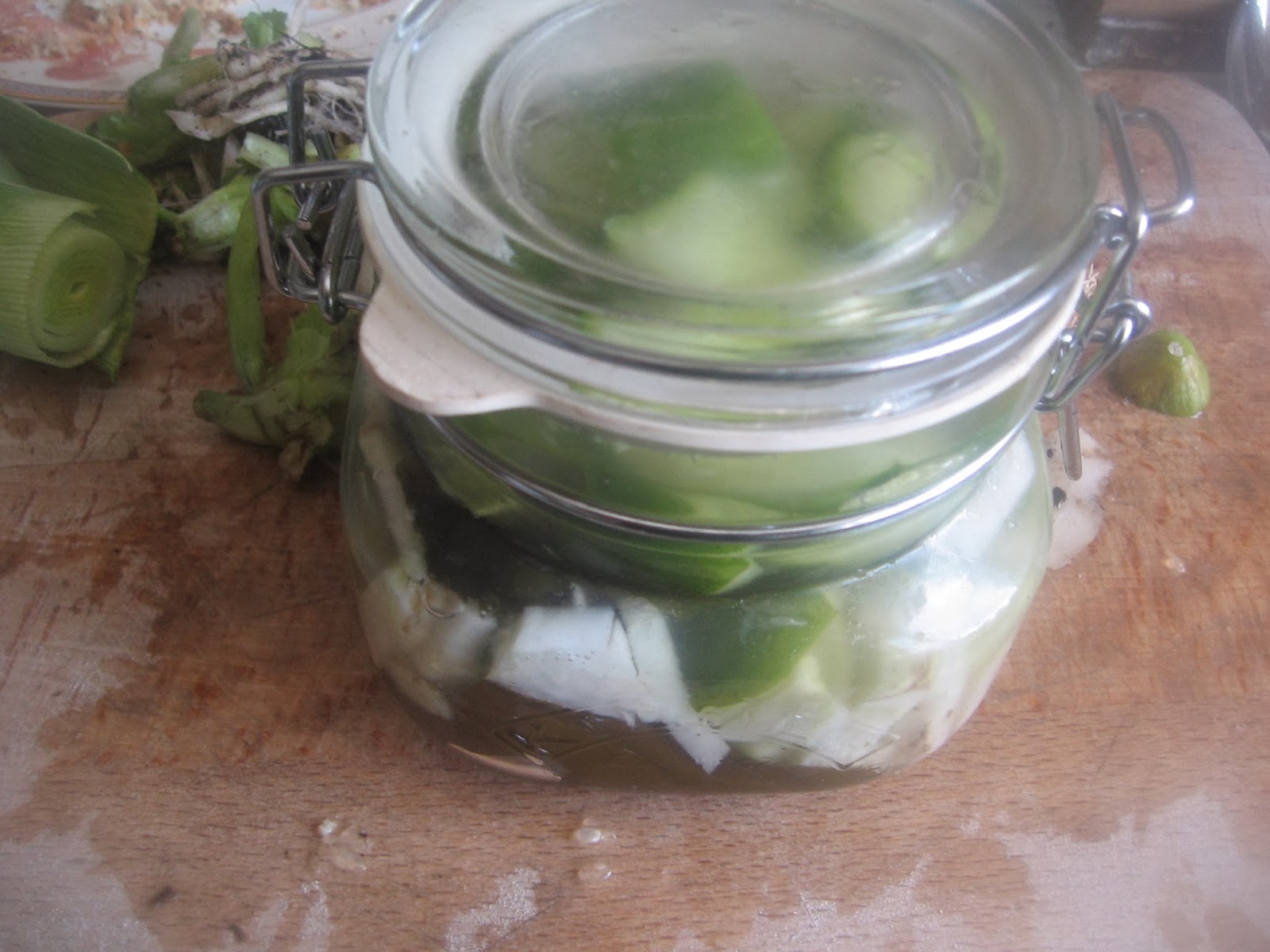
metal) or the good old ziplock plastic bag. I used a fancy French jar!! Moving up in the world.
Put the cucumber and wakame
seaweed in. Stir or shake around, seal well and let marinade in the
refrigerator for 2-3 hours or overnight.
Drain off the marinade and serve in small bowls. This should be eaten within 2-3 days.
You can reuse the marinade once: let it come to a boil, cool off, and put in fresh vegetables.
Besides cucumbers try sliced turnips, carrots, daikon radish, regular radish, etc.
I served the pork and pickles with some regular rice nori and finely shredded greyhound cabbage that worked really well.
Thanks for reading, I hope you try and enjoy this - also works very well with chicken.
Please do take the time to comment, I really do appreciate the time and effort taken - and its nice to know someone is reading these postings
Happy new year to one and all. I do know that I have been updating very little in the last year, but that has been due to moving from Connemara to Cork, and working a great deal at sea.
Good news is I have applied for an allotment in Cork, and will be getting back to growing and cooking.
So, the one thing - which I wrote about a while back, was the use of seaweed in traditional Irish recipies.
Nori are probably the most identifiable Japanese food. Most people associate this delicate looking and delicious seaweed
wrapped Japanese treat with the exotic east - and yet it was eaten in
Ireland as a staple of the poor for centuries, and the same type of sea veg used to make Nori was eaten in Ireland but known as Sleabhac (pronounced Schlowk).
A very good UK based company producing Nori sheets and a very wide range of dried seaweeds are Clearspring and they are quite widely available in Ireland as well as having an online store.
But Nori itself can be made the main attraction. nori sheets, along with sushi rolling mats are easily found in most health stores.
Personally I tend to shop in the English market a lot - the people across the way from Mr Bells in particular.
I tried to make a type of Irish bulgar wheat one year, using oats - but that failed and was simply too much work, so I just gave up on that and bought bulgar wheat.
In this recipe, I use it to replace expensive sushi rice, and do a quick Irish nori using Bulgar - which in theory I could grow and make myself here in Ireland.
It could not be easier to prepare.
Prepare the bulgar in to a Tabbouleh - in this case it is an Armenian version called Eech.
Anyway, you will need:
Bulgar wheat, 1 cup
Boiling water, 2 cups
Shallot - very finely sliced
Fist full of parsley, very finely chopped
dash of olive oil
Pack of Nori leaves, toasted (most health stores have them)
Half a lemon, squeezed.
Cucumber
Small pack smoked salmon
It could not be easier to prepare.
You will need:
1 cup of Bulgar wheat
2 cups boiling water
1 very finely sliced Shallot.
A handful of parsley - finely chopped.
Half a lemon, squeezed.
Prepare the Bulgar in to a Tabbouleh - in this case it is an Armenian version called Eech.
Put the Bulgar wheat and shallot in a bowl
Add the boiling water and cover
after 15 minutes add the parsley, lemon juice and olive oil to mix through
That's it - Sin E !!!!
Lay the toasted Nori sheets on the sushi mat.
I layered on some smoked salmon slices, then some very thinly sliced cucumber.
After that about a centimeter depth of Eech/Tabbouleh
Baton of cucumber in the center
Roll
Slice
Serve with a little dollop of homemade horseradish sauce.
I topped mine with a little wasabi and shop bought pickled ginger.
In future, I'd use home grown horseradish sauce - after all wasabi is just Japanese horseradish - and I'd leave out the ginger.
Looks great, and tastes great.
I topped mine with a little wasabi and shop bought pickled ginger.
In future, I'd use home grown horseradish sauce - after all wasabi is just Japanese horseradish - and I'd leave out the ginger.
Looks great, and tastes great.
Think of it - to paraphrase Basil Fauwlty as a Hiberno / Nipponese cucumber sandwich.
Actually, with the fillings it would be Hiberno / Nipponese / Turkish / Armenian hybrid !!!!
I wonder if with reference to my new home would it is a little too much to call it a Cork Norrie recipe??
Although this is my own recipe, if you are interested in cooking with seaweed I still have to say you should invest in Dr. Prannie Rhattigans great book - Irish Seaweed Kitchen
Enjoy - and please feel free to leave a comment - I really do appreciate the time, effort and feedback.
Ketchup, the All Tomato, All American condiment - its history is a little more scattered and far more interesting than that, and very apt to my current wanderings. With Summer and BBQs it is really cool, and interesting, to have as much as possible from your own garden, so why not the condiments!! So, a little history and some tried and tested recipies. Use your heaviest pot for these. The name 'Ketchup' is derived from Amoy dialect Chinese - kôe-chiap or kê-chiap meaning
"brine of pickled fish or shellfish", and had no tomatoes.
The table sauce made it to the Malay
states - Singapore and Malaysia.. In Singapore and Malaysia, one can find ketchup based on
banana's, lemons and other staples, tied in with vinegar, salt, spices and sugar-
think of it sort of like South Asian chutney. The Indonesian-Malay word for the sauce is kicap, or kĕchap , which just means sauce That word evolved into the English word "ketchup" It was first
introduced to the West in the 17th century by sailors returning from
voyages to the Far East, and has since evolved into the tomato-vinegar
based sauce we know today. In 1690 Catchup was recorded in the dictionary as " a high East-India Sauce" In 1730 our own Jonathan Swift in Panegyrick on the Dean - "And, for our home-bred British cheer, Botargo, catsup, and caveer" Early ketchup's were heavy on salt, thin and quite vinegary - more like today's Worcestershire sauce but by the early to mid 19th century the Americans had begun to sweeten their ketchup, and tomatoes had begun to become more acceptable. A man named Jonas Yerks
(or Yerkes) is believed to have been the first man to make tomato
ketchup an American phenomenon. By 1837, he had produced and distributed
the condiment nationally. Other companies followed suit - like Heinz who launched their tomato ketchup in 1876advertised as "Blessed relief for Mother and the other women in the
household!" As food laws became stricter - so did preservatives etc. Ketchup was originally saltier, thinner and with more of a vinegar kick. With the banning of sodium benzoate Heinz and others went for more sugar The Websters Dictionary of 1913 defined ‘catchup’ as: “table sauce made from mushrooms, tomatoes, walnuts, etc. [Also written as ketchup].” But it was the tomato version that became the dominant condiment on the American, and most European, tables through the 20th century. This mushroom ketchup is with fish, chicken, meats or pasta, and,
as usual, when you make it yourself you control the ketchup
ingredients, so you get it preservative and gunk free, you control the
sugar levels, and you can even prepare it as organic ketchup. Real
'gourmet ketchup'! So why not go ahead and give this great homemade
ketchup recipe a try? 2 lbs (900 g) mushrooms, preferably large, open ones 2 oz (56 g) salt ½ teaspoon ground allspice A pinch of ground mace A pinch of ground ginger A pinch of crushed cloves A pinch of cinnamon ½ pint (285 ml) brown malt vinegar Wash and dry the mushrooms, trim off the ends of the stalks if necessary but do not peel them. Chop into small pieces Layer the mushrooms in the salt in a large bowl. Cover and leave for 24 hours and then rinse and drain. Place in a pan with the remaining ingredients and bring to the boil, reduce the heat and simmer for 30 minutes. Strain through a sieve and pour into hot, sterilized, bottles and seal. And Horseradish Ketchup
473.18 ml horseradish, grated
236.59 ml cider vinegar
236.59 ml olive oil
4.92 ml salt
59.14 ml sugar
14.79 ml dry mustard (Coleman's preferred)
1.23 ml ground pepper
Directions:
1
Blend all ingredients together very well.
2
Pour into half pint jars.
3
Cover and refrigerate.
==========================
Pork Ketchup
INGREDIENTS:
3 pounds apple, tart, cored, peeled & quartered 1/2 cup water 1 1/2 cup white vinegar 1/3 cup horseradish, freshly grated 3/4 cup sugar, granulated 2 teaspoons salt 3/4 teaspoon cinnamon, ground 3/4 teaspoon black pepper 3/4 teaspoon dry mustard powder 1/4 teaspoon ground cloves
DIRECTIONS:
Combine
the apples and water in a large, heavy saucepan. Cook the apples,
uncovered, over medium-low heat, stirring occasionally, until the apples
are soft and have dissolved into a lumpy sauce, about 30 minutes. (The
amount of time will depend on the variety of apple used.) Remove the pan
from the heat and let the apple-sauce cool a few minutes. Transfer the applesauce to the container of a food processor. Process
the sauce until smooth. Rinse out the saucepan and return the applesauce
to it. Add the vinegar, horseradish, sugar, salt, cinnamon, pepper,
mustard and cloves. Bring the ketchup mixture to a boil over
medium-high heat, stirring frequently. Reduce the heat to low and simmer
the ketchup, uncovered, for 30 minutes, stirring frequently. Remove the
ketchup from the heat and let it cool to room temperature. Store the
Apple-horseradish ketchup, covered in the refrigerator for up to 2
weeks.
This time of year in Connemara, the hedgerow briars come forward with a luscious crop of blackberries - but blackcurrants work equally well.
We see fig, orange and pomegranate based salads on TV but our own homegrown earthy sweet of beetroot and the zesty sweetness of foraged fruit sing of late summer and early autumn.
It is a great seasonal treat, and you really don't have to forage all that many - its only 200 grams, about a tea mug full.
As an unusual but the delicious combo I would go so far as to call it an almost exotic dish from a small garden plot.
and yet the food miles are minimal for most home gardeners as most of us have a few beets and an onion somewhere in the beet patch.
Great as an appetizer but really, really, really good with cold roast duck, pork or game.
Also, if you freeze a few blackberries now and store some beets, its great with cold turkey just after Christmas.
Iphone pic - slight variation using strawberries and loganberry-applevinegar
INGREDIENTS
1 bunch baby beetroot.
About 200 grams of blackberries or blackcurrants.
Half a small red onion, diced or very finely sliced.
Tablespoon honey - local if you can find it (or caster sugar if you like)
Beet leaves, Bay leaf or mint to garnish
Lightly scrub the beets, remove the leaves - they can be used as a garnish
Boil the beets in lightly salted water
Rinse your blackberries
Melt the honey down in about a tablespoon of water
Gently warm the blackberries in the warmed honey-water until they start to release their colour and soften.
Don't stir the pan, just shake it to avoid crushing the fruit.
Add a little more water by the tablespoon if required, you are looking to create a very light syrup.
When the beets are cooked, drain them and slip the skins off as soon as they are cool enough to handle.
Slice into the beets into rings and arrange on a shallow plat.
Sprinkle over the onions and season to taste.
Spoon over the fruits with a slotted spoon and reduce the syrup a little further.
Pour over the syrup and leave the dish to cool
Serve with cold game or pork, and maybe use the beet leaves as a garnish.
And as I said before, it makes a great post Christmas accompaniment to turkey or ham
Comments are, as always, most welcome - photos will follow, but it may take a while, left camera with pics at home without downloading them - if someone wants to send some in please feel free to do so.
ADDENDUM SEPTEMBER 2012
These pictures were taken in Holland, a slight variation on the original. I used strawberries - and instead of water, I used a lovely Swedish vinegar - lingonberry and apple cider vinegar - available at Ikea - but it does demonstrate the colours you can expect. There are other fruit vinegars more available in Ireland. Experiment with what fruit you can grow or forage.
This is how baked beans really, the original American style.
On occasion, a tin of baked beans is alright, but it cannot be confused with the real McCoy - those are just a facsimile of this American classic.
It is very adaptable, chilli can spice it up - chorizo or other dried spicy sausage can be worked in - but this is just a simple, straight forward variant that is great with a dash of Tabasco after serving.
You are using a very economical cut of meat, a few bits and pieces from the cupboard and a jar of beans - hopefully ones you've grown and dried yourself. Most people grow beans as a part of crop rotation in their kitchen gardens.
A dutch oven or heavy casserole pot are ideal for making this dish - it
would have been cooked out of a chuck wagon or over a camp fire back in
the day.
Potatoes
have become the Irish staple in a meal, but the cultivation of beans
and the curing of pork predate the spuds introduction to Ireland, so
this is really looking back in a way.
There was a poem the - Chisholm Trail - from a Time life book about cowboys that I loved as a kid from which I've always remembered a few lines, about bacon and beans.
I'm up in the momin' afore daylight
And afore I sleep the moon shines bright.
No chaps and no slicker, and it's pouring down rain,
And I swear, by God, that I'll never night-herd again.
Oh, it's bacon and beans most every day
I'd as soon be a-eatin' prairie hay.
I went to the boss to draw my roll,
He had it figured out I was nine dollars in the hole.
I'll sell my horse and I'll sell my saddle; You can go to hell with your longhhorn cattle.
This recipe is based on one best known as Boston Baked Beans - but this is a time reduced version I threw together in Blessington - easily feeds 4 hungry hearty lads.
The Boston classic uses belly of pork - I went for a mild cure bacon.
If you are using bacon don't add salt,more than enough will come off the meat and infuse into the beans.
The meal is salt and sweet - you could almost call it an American style cassoulet -beans and pork from an oven
INGREDIENTS
450 grams dried white haricot beans, dried.
1.7 litres water
Cannellini and other dried white beans are also excellent in this.
Pour the water into a heavy based saucepan - oven suitable if you have one.
Add the beans and bring to the boil for about 5 minutes
Remove the heat to a simmer and stir in the bay leaf, honey, tomato puree, mustard powder, garlic and onions
Put the bacon or ham into the pot and ensure it is near the bottom - covered with the beans.
Leave at a steady simmer for 45 minutes or until beans are fairly soft and bursting from their skin
After 45 minutes to an hour the liquid should be well reduced.
Lift the meat out of the pot and cut slashes into the rind.
Smear on the brown sugar, the wetness of the rind should make it melt a fair bit - smear it well.
Sprinkle over the allspice at this stage.
Return the meat to the pot or oven dish buried into the beans but with the rind just clear of the liquid.
There should be enough liquid to just cover the beans - top up with a little water if needed.
Transfer the covered pot or oven dish to a pre-heated oven on a moderate heat, about 120 degrees centigrade for 50 minutes.
Uncover the pot after 50 minutes and leave the dish in the oven for around another 20.
Serve very hot with a good larger, hotsauce and some crusty bread - and enjoy.
Beans and cured pork were staples in the
wild west - as shown in a notorious scene in Blazing Saddles, a movie made in the worst possible taste - and one of my favorites.
This is possibly the easiest cold desert in the world. Kulfi, or Qulfi, is kind of Indian Ice cream but without the need for an ice cream maker. It's very popular on the subcontinent - this is just
an Irish twist on it using home grown fruits, local honey and two great Irish ingredients, Carolans Irish Cream and Glenisk yogurt
Sorry 'bout the photo - using an iphone
A really tasty, dense texture, it has tones of a toffee flavour because of the evaporated milk and the cardamom gives it a surprising depth - a nice contrast.
The recipe itself was inspired by and developed from Camillia Panjabi's 50 Great curries of India which is a great book that deals with the various different cuisine styles right across the sub continent, not just concentrating on food from Punjab - most familiar to us - as most books do.
Her explanations of regional, caste and religious aspects are clear and precise, and it goes a long way towards developing our understanding of such a fascinating and vast food culture.
With the recent good weather its a great time to consider
alternatives to ice cream like sorbets or a little more exotic like this kulfi. In India popular
flavors include pistachio, mango, vanilla, and rosewater.
At this time of year, foraging for fruits like blackberry or strawberry is both fun and rewarding, so if you have spent a few hours going through hedgerows then this is a great reward for all your efforts.
As for the alcohol content, that evaporates in the heating process, so you can safely let kids enjoy this.
Its not churned like our ice cream so you don't need a special machine to make it, just a freezer and a tin
Because of its density, kulfi takes a longer time to melt than Western ice-cream. It can be set in molds or glasses with a stick like ice lollies etc. or just set in a small tin as I do.
One great advantage is though it keeps in the freezer like ice cream, unlike an ice cream, it's no problem to re-freeze.
Traditionally Kulfi was made by reducing milk over a long period requiring constant stirring, but using condensed or evaporated milk, or in my recipe, Carolans Irish Cream make a far easier and quicker alternative.
There are many recipes online for kulfi, some use various combos of condensed, evaporated or powdered milk as well - but this one is as always set to be as simple and straight forward as possible.
The second time I made this, the first was about three weeks ago using blackberries but recently I was staying with friends 300 yards into Kildare over the border from Wicklow - and they have the most wonderful wild strawberries which I added to the mold - so that's where the Qulfi Cill Dara name comes from, I used blackberries in the last one I made so I would call it Connemara Kulfi - but that's for another day.
INGREDIENTS
450ml Evaporated milk*
450ml Carolans Irish Cream
3 Cardamom pods
3 big tablespoons Glenisk whole milk organic yogurt **
4 tablespoons honey or sugar, I prefer using honey
Seasonal sweet soft fruit, like wild strawberry, blackberry, currants or raspberry
Optional: A few strands of Saffron - or half a teaspoon of turmeric powder for colour
*the Carolans and Evaporated milk are interchangeable, you can use more or less of both.
** You can use double cream, but I have found the yogurt gives a better texture, and you can of course use a flavored yogurt like vanilla if you like, the Glenisk vanilla yogurt has real vanilla seeds in it as opposed to essence.
Add the honey and cardamom pods to the Carolans and evaporated milk in a heavy based saucepan.
Cook over a low heat for about 10 minutes, stirring and scraping the sides and bottom of the saucepan.
After ten minutes remove from the heat and strain through a fine sieve to remove the cardamom pods, seeds and saffron strands if you are using them.
Leave aside until it has cooled a bit, about hand temperature is fine, then stir in the Yogurt and fruits if you are using them.
Pour into a mold or tin and chuck it into the freezer for 4 or 5 hours, overnight is fine.
To remove from the mold or glass, dip the container into warm water and press out the kulfi. I serve in slices with a sprig of mint
- hope you enjoy it, photos coming soon.
As always I really appreciate it when people take the time to comment, or suggest alternative variations.
Just to add, it is possible to make your own evaporated milk - I have not done so, yet, but Imen from the great website marriedanirishfarmer.com has done so - as well as her own condensed milk.
According to her - and I would believe it - the 'flavour is far superior to any version of the same in a tin with a supermarket shelf life of six months or more.' and I would believe her - must try it sometime.
This is her way of doing so Farm Fresh Homemade Evaporated Milk 2 litres whole milk from your farm or local dairy (from the store is fine as well) In a heavy-bottomed pot, bring the milk to a boil over medium heat. Reduce the heat to low and simmer very gently for about two hours
until the volume is reduced by 60%. The milk should be barely simmering
and never bubbling at any point. Stir every 15 minutes or so to keep
the milk from burning on the bottom. Remove the pot from heat and let the milk cool. The milk will thicken further after it has cooled. Will keep in refrigerator for 2 weeks or more.




.JPG)


